

IT’S NOT ABOUT DRIVING
IT’S ABOUT FEELING
There are sports cars.
And then there is the Porsche 911.
An icon is a word that gets overused.
An archetype is something far rarer.
The 911 is not just a car you recognize — it is a shape you remember.
Even if you have never driven one.
Even if you have never owned one.
Even if you have only seen it disappear down a road at dusk.
Every manufacturer has tried to replicate it.
Some have copied the silhouette.
Others the engine layout.
Many the mythology.
None have captured the feeling.
Because for most people, a 911 is reduced to numbers: horsepower, acceleration, lap times, price.
A performance machine.
An expensive toy.
A status symbol parked outside a restaurant.
But for those who understand it — truly understand it — the 911 exists on a different level entirely.
It is not an object.
It is not a product.
It is not even a machine in the traditional sense.
It is a pulse.
A vibration.
A continuous, electrical conversation between human and mechanism.
And once you feel it, you never fully disconnect from it again.
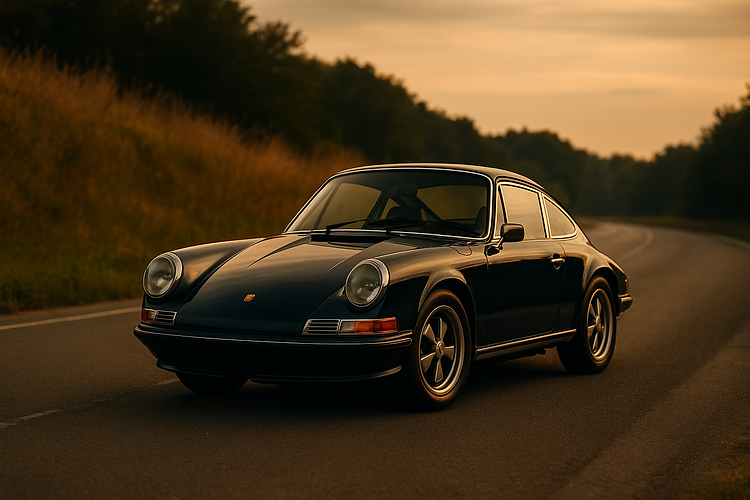
From DRIVIN911 – 911 Chronicles
Approach a 911 — any 911, from any era
— and something happens before you consciously register it.
The proportions feel right.
Not fashionable. Not aggressive. Not overstated.
Just inevitable.
The soft curve over the rear wheels.
The low, almost humble nose.
Lines that have survived decades not because they were frozen in time — but because they were never chasing it.
This is not retro design.
It is continuity.
You open the door.
That sound matters.
Because it tells you everything.
Not a dull thud.
Not an exaggerated slam.
But a precise, mechanical click — like the closing of a finely made instrument. A Swiss watch translated into steel, leather, and intent.
You sit down.
You don’t climb into the car — you settle into it.
The driving position wraps around you.
The wheel is where your hands expect it to be.
The pedals are aligned with intention, not compromise.
You don’t feel like a passenger waiting to be entertained.
You feel involved.
You are not inside a cockpit designed to impress you.
You are inside a machine designed to include you.

Nothing in a 911 is accidental.
Nothing is placed for drama.
Nothing exists to fill space.
The ignition key sits on the left — and it still does, decades later.
Not because it looks cool.
Not because it’s quirky.
But because of Le Mans.
A decision rooted in racing necessity, carried forward into the present day as a quiet act of defiance.
A reminder that this car remembers where it came from — even when the world moves on.
You turn the key.
The engine does not politely wake up.
It does not ease into existence.
It is summoned.
The sound is raw, immediate, and unmistakably mechanical.
No filters.
No synthesized enhancement.
No attempt to soften the truth.
This is not noise.
It is character.
And then something rare happens.
The car begins to tell you the truth.
Not just about the road — though every surface, camber, and imperfection speaks clearly through the wheel.
Not just about physics — though weight, grip, and momentum are laid bare without apology.
But about you.
Your inputs matter.
Your hesitation is exposed.
Your confidence is rewarded.
Your mistakes are not hidden — but they are explained.
There is no artificial buffer between cause and effect.
No digital insulation.
No illusion of perfection.
It is you. The road.
And engineering that feels alive, responsive, and unapologetically honest.
This is not driving as consumption.
This is driving as participation.
